[et_pb_section fb_built=”1″ admin_label=”Case Study #1″ _builder_version=”4.9.4″ _module_preset=”default” custom_padding=”||||false|false” hover_enabled=”0″ collapsed=”off” sticky_enabled=”0″][et_pb_row _builder_version=”4.9.4″ _module_preset=”default” custom_padding=”||0px||false|false”][et_pb_column type=”4_4″ _builder_version=”4.9.4″ _module_preset=”default”][et_pb_text _builder_version=”4.9.4″ _module_preset=”default” header_text_align=”center” header_text_color=”#437fb6″]
Case Study #1
[/et_pb_text][et_pb_divider color=”#4576b3″ divider_weight=”2px” _builder_version=”4.9.4″ _module_preset=”default” width=”100px” module_alignment=”center”][/et_pb_divider][/et_pb_column][/et_pb_row][et_pb_row column_structure=”1_2,1_2″ use_custom_gutter=”on” gutter_width=”2″ _builder_version=”4.9.4″ _module_preset=”default”][et_pb_column type=”1_2″ _builder_version=”4.9.4″ _module_preset=”default”][et_pb_image src=”https://globodent.com/wp-content/uploads/2021/06/Case-1-Pre.jpg” title_text=”Case-1-Pre” _builder_version=”4.9.4″ _module_preset=”default”][/et_pb_image][et_pb_text admin_label=”Text” _builder_version=”4.9.4″ _module_preset=”default” header_2_font=”|600|||||||” header_2_text_align=”center” header_2_text_color=”#45bfbf” header_2_font_size=”23px” header_4_text_align=”center”]
Pre-treatment
[/et_pb_text][/et_pb_column][et_pb_column type=”1_2″ _builder_version=”4.9.4″ _module_preset=”default”][et_pb_image src=”https://globodent.com/wp-content/uploads/2021/06/Case-1-Post.jpg” title_text=”Case-1-Post” _builder_version=”4.9.4″ _module_preset=”default”][/et_pb_image][et_pb_text admin_label=”Text” _builder_version=”4.9.4″ _module_preset=”default” header_2_font=”|600|||||||” header_2_text_align=”center” header_2_text_color=”#45bfbf” header_2_font_size=”23px” header_4_text_align=”center”]
Post-treatment
[/et_pb_text][/et_pb_column][/et_pb_row][et_pb_row _builder_version=”4.9.4″ _module_preset=”default”][et_pb_column type=”4_4″ _builder_version=”4.9.4″ _module_preset=”default”][et_pb_text admin_label=”Title” _builder_version=”4.9.4″ _module_preset=”default” header_2_font=”|600|||||||” header_2_text_align=”center” header_2_text_color=”#45bfbf” header_2_font_size=”23px”]
57yrs with darker yellow shades, responding well to tooth whitening
[/et_pb_text][et_pb_text _builder_version=”4.9.4″ _module_preset=”default” text_font_size=”16px” text_orientation=”center”]
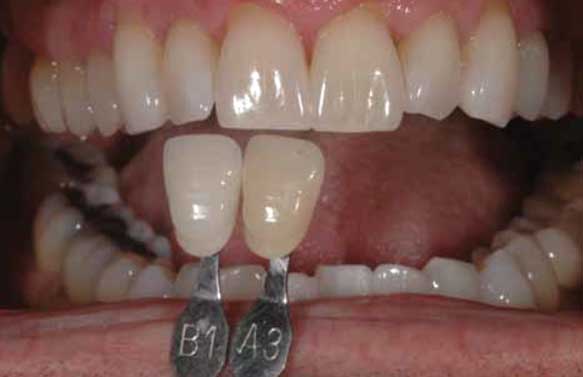
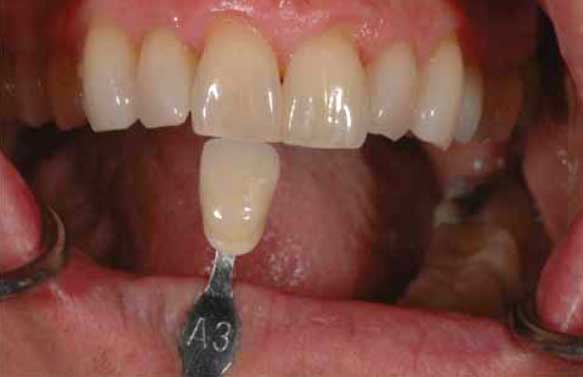
The shade was taken with the Vita Classic shade guide prior to in-office whitening. The number of shade shifts for tooth whitening is traditionally determined by the Vita classic shade guide arranged by value rather than with the standard arrangement by chroma. (Figure 4a) Each shade tab is referred to as one change in shade, but actually each shade tab more closely represents two or three shade changes. The gingiva and exposed cervical dentin were isolated with liquid dam prior to performing the BlanQuest® Pro In- Office tooth whitening procedure. The teeth were treated with three 10-minute sessions of BlanQuest® Pro in-office whitening and with use of an in-office light. The shade was then taken a second time at the end of the appointment using the same Vita Classic shade guide. The shade shift in this case was eight shades, based on the number of shades from A3 to B1. (Figures 4b, c) The anterior eight to ten teeth in both arches were whitened on the labial surface only. This provides adequate coverage for all the visible areas in most smiles.
[/et_pb_text][/et_pb_column][/et_pb_row][/et_pb_section]